Dental implants
Replacing a lost tooth with a titanium root and a crown made from a digital impression.
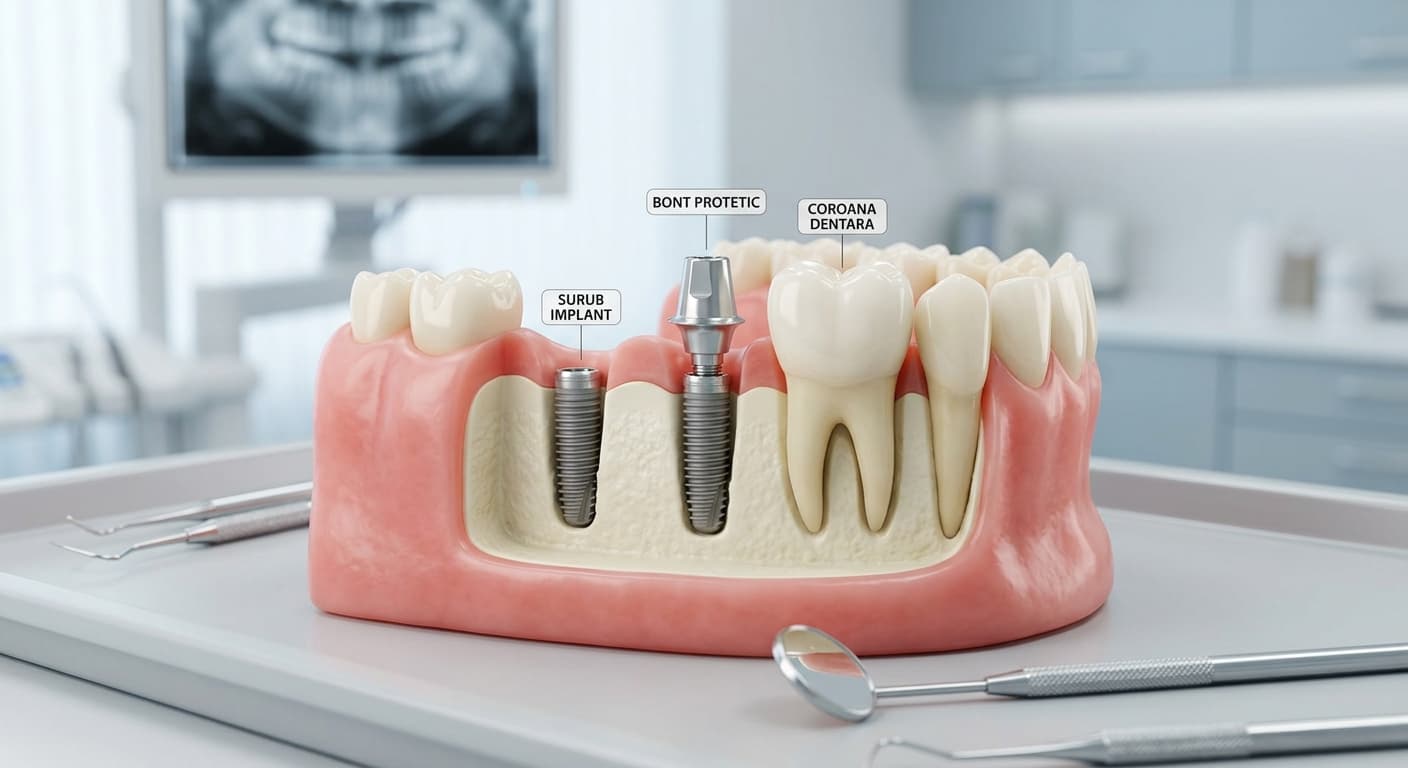
A dental implant replaces a lost tooth with an artificial titanium root placed in the bone, with a crown fitted on top. The new tooth stands on its own, without leaning on the neighbouring teeth, and looks and works like a natural one.
It suits adults who have lost one or more teeth and want a fixed solution. Before anything else, we show you on your X-ray whether an implant is right for you and what your other options are.
Suitable if
- One or more missing teeth.
- A removable denture that no longer fits well.
- Enough bone, or the option of a bone graft.
- Wanting a fixed restoration that doesn't touch the neighbouring teeth.
Not suitable if
- Heavy smokers, until they cut down.
- Uncontrolled general conditions that affect healing.
- Active gum disease, until it is treated.
- Patients whose jaws are still growing.
Your alternatives
A missing tooth can be replaced in three ways, and each has its place:
- An implant stands on its own in the bone and doesn't touch the neighbouring teeth. It takes a small procedure and a few months of healing.
- A dental bridge rests on the teeth either side of the gap, which are reshaped for crowns. It takes a few weeks, with no surgery on the bone.
- A removable denture comes out of the mouth. It is the simplest option, especially when many teeth are missing, but it is less stable.
We compare them in detail in the guide Implant or dental bridge. At the consultation we tell you which suit your case and why.
How it goes
Consultation and plan
It all starts with a consultation, followed by a CBCT scan and a panoramic X-ray. The images show how much bone you have and where, and you then get a written plan with the options, the stages and an estimate.
Preparation
Before the procedure we treat any decay or gum problems. If needed, we ask for a few blood tests and talk to your own doctor about the medicines you take. Where there isn't enough bone, a bone graft comes first.
The treatment itself
Implants are placed in a single visit, under local anaesthetic, usually in under an hour for one implant. Healing into the bone follows, and during that time you can wear a temporary restoration if needed.
Check-ups and maintenance
Once the implant has integrated, we fit the abutment and the crown, made from a digital impression. You then come back for regular check-ups and cleans, so the gum around the implant stays healthy.
How long it takes overall
- Consultation and CBCT
- one visit
- Bone graft, if needed
- a few months before
- Placing the implant
- under an hour
- Healing into the bone
- 3–6 months
- Abutment and crown
- 2–3 visits
What the cost depends on
The cost of an implant isn't the same for everyone, because it depends on what the X-ray shows. What matters is how many implants are needed, whether the bone first needs a graft or a sinus lift, and the type of crown you choose.
You get the estimate after the consultation, in the written plan, with every stage and what it includes. For larger treatments, payment can be spread in stages as the work progresses. More on how cost is set in the guide to treatment cost.
Costs
How the cost of a treatment is set →What you will feel
The implant is placed under local anaesthetic, so during the procedure you feel pressure and vibration, not pain. We tell you every step beforehand, and if you want a break, we take one.
Once the anaesthetic wears off there is some discomfort, usually less than after an extraction, which eases with the recommended painkiller. Swelling peaks on the second or third day, then goes down. If you are anxious, tell us at the start: the first consultation is for explaining, not for treating.
Risks and limits
Like any procedure, an implant has limits. Sometimes it doesn't integrate into the bone, more often in smokers or when other conditions slow healing; it is then removed and, once healed, can be placed again.
Long term, the gum around an implant can become inflamed if cleaning isn't thorough, just as around a natural tooth. Regular check-ups keep an eye on it. Planning on a CBCT scan reduces the risk of reaching nearby structures.
After treatment
In the first days you hold ice on your cheek, eat soft food and don't rinse hard. The check-up after a week looks at healing, and the crown is fitted once the implant has integrated. Everything, day by day, in recovery after a dental implant.
After this treatment
Common questions
- How long does treatment take?
- The implant itself is placed in a single visit, usually in under an hour. Healing into the bone then takes three to six months, after which the crown is fitted.
- Does it hurt?
- Everything is done under local anaesthetic, so discomfort is minimal. Afterwards, the pain usually eases with the recommended painkiller.
- How often do I come back for check-ups?
- It depends on each case: at 3 months, 6 months, a year. Professional cleaning remains part of the maintenance.
- Can I have an implant if I lost the tooth long ago?
- Most of the time, yes. The bone shrinks over time, so sometimes a bone graft is needed first. It shows on the CBCT scan.
- Will I be without a tooth while the implant heals?
- Not necessarily. Where it shows, you can wear a temporary restoration until the final crown.
- How long does an implant last?
- With good cleaning and regular check-ups, an implant can last many years. We don't promise a specific lifespan, because it also depends on your gums, your bone and habits such as smoking.